Witness to the Flames
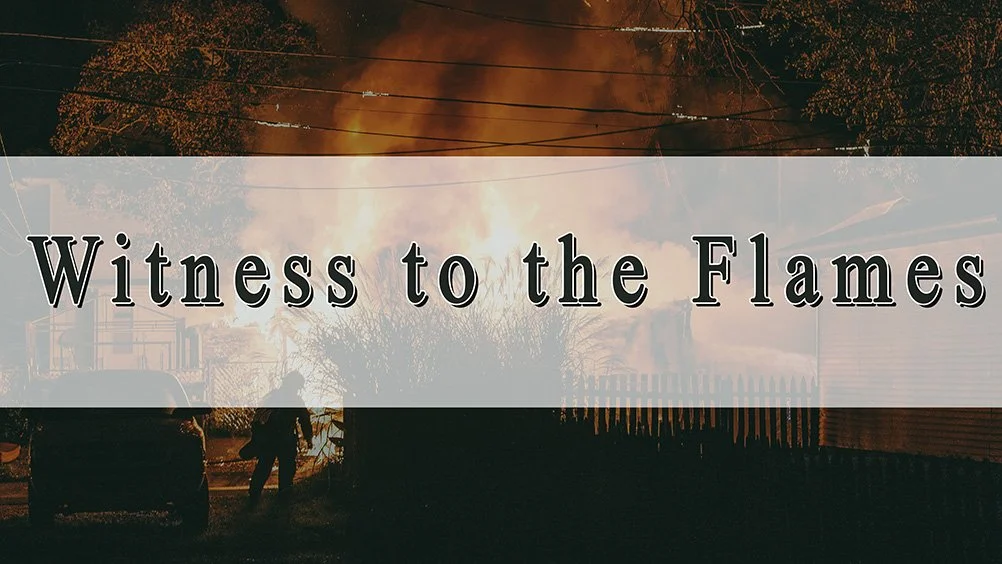
Photo by Kyle Cleveland on Unsplash
When a young girl sees something she shouldn’t, can she do what’s right or
will the consequences of speaking be too much for her?
We didn’t have assigned seats, but everyone naturally avoided the desk where Olivia usually sat. It was in the front row, second from the window. She’d sit in class and sometimes take notes or doodle with her colored pens. Purple must have been her favorite color. She used it the most.
Mr. Garrett had her notebook on his desk, maybe waiting for her return. But she wasn’t coming back, and he might not know what to do with a book for a student who no longer attends; a notebook now belonging to an empty space in the room that no one but me notices. I watch the space every day in fourth period, but like everyone else, I say nothing about it.
The Stone Harvest, my debut novel
I often find myself drifting through the house at all hours, making tea that I’ll never drink or scrolling on my phone, hoping to be entertained until the fatigue finally grows strong enough. On the night of the fire, I sat at my desk by the window, writing in my journal, when I saw the truck. I’d seen it before in the church parking lot a hundred times: dark blue, lifted high, cracked rear window. No lights on, engine running, waiting. Across the street and two houses down from the Andersons’ place. Someone dressed in dark clothing moved along the back side of their house, someone whose walk and movement were familiar to me. Their face was covered by a dark hoodie over their head, but everything seemed to fit with who it might be. Minutes later, a fire started outside along the back side of the house, not inside, where they later said it did. I woke my parents and had them call the fire department.
Back in my room, on a fresh page of my journal, I wrote everything down that I saw: the truck, the man, who I thought it was, and where he went. It seemed important to do that, even though I never told my parents about what else I saw.
Faulty wiring, they said.
Father is on the city council and coaches Little League baseball. He knows which hands to shake and what questions to ask. At the council meeting discussing the fire, my father just nodded along and frowned like he had already made peace with the decision. Now and then, I recall that he, like me, was awake the night of the fire, and seemed almost mad at me for witnessing anything.
On a Tuesday, I came home early and heard him in the kitchen. He didn’t see me. He said something about the insurance company flagging the claim, and it could be months before it gets settled.
A pause.
“Well, that’s not really our problem, is it?”
He laughed in that way that older men do when something isn’t funny. My stomach churned violently. It churned because the ground underneath me moved, shifting my understanding of what my world had been built on.
Upstairs, I sat on my bed and looked at the journal on my nightstand.
Our problem. As though the Andersons losing their home were a random act rather than something done to them.
Deadlined, a Karl Warren story
I start doing the math in my head about gains and losses. How much weight is there in a journal entry of a teenage girl? Does that entry have enough weight to unblock the flow of some kind of belated justice? There are Father’s years on the city council and as a deacon. There’s the college recommendation letter sitting in the principal’s computer, waiting to be sent contingent on my being a good girl. How much could I lose?
Then I think of the empty chair in class and the sight of the rising flames.
I found Olivia’s profile through Sajni, who shared a class with us and is still friends with her online. In a DM, I ask if she’s okay. I know she can’t be, so it’s a stupid question.
“We’re in my aunt’s apartment. Four of us in two rooms. Mom doesn’t sleep.”
I stare at that and think of my own wandering at night.
“I’m sorry. I’ve been thinking about you,” I type.
“We’d finally found a place,” she writes back. “My dad checked out every town around to find the right house. He said it seemed like people would accept us.”
It wasn’t an accusation, but it landed like one. Her neighborhood struck them down, and I was part of that neighborhood. Deep down, I knew what I was going to do and why. I had to do something because I wasn’t the one suffering here. I’d been balancing action and inaction as if I were the one paying the bill, but I really wasn’t. The Andersons had already paid it. Their loss had been the raw material for my turmoil over the past days. Whenever I came close to feeling a type of calm, all I needed to do was think of their messed-up situation, and I would hurtle towards another round of confusion.
It was time to pay up.
With the journal open to the page with the entry from the night of the fire, I took a couple of pictures with my phone to make sure I captured everything I wrote.
What will come next? What will Olivia do with the information? Will it be enough? Will Father look at me differently when he comes home or across the dinner table?
I think about the empty desk in fourth period, the one that nobody wants to sit at yet.
I press send, and a read receipt appears almost immediately. She’s been waiting, like she knew I knew something. Now it’s my turn to wait, to see what comes of this simple action.
Outside, it’s dark. My father’s car pulls up in the driveway. Somewhere across town in her new and uncomfortable home, Olivia Anderson is looking at her phone.